








BEYOND DIGITAL

Why Service Structures Reach Their Limits in Growing Companies

In fast-growing companies, not only does the number of employees or customers change – the demands placed on customer service increase rapidly as well. What used to be manageable with a small team and a few Excel spreadsheets quickly turns into operational challenges in larger teams that can no longer be handled without the right processes and technology.

Increasing Pressure: More Requests, Higher Expectations

In the early stages of a company, customer service can often be managed intuitively: A team answers emails, distributes tasks, and ensures that requests are resolved. However, as complexity increases, the volume of inquiries expands beyond email to include channels such as chat, social media, and phone. Customers today expect not only fast responses, but also consistent and personalized communication — around the clock and across all channels.

This development pushes traditional service structures to their limits, because:

  • ticket volume grows faster than team size
  • repetitions, duplicate work, and lost tasks become more likely
  • important information is easily overlooked
  • leadership loses visibility into response and resolution times


This shift is not a minor inconvenience: Inefficient customer service costs not only time, but also long-term customer retention.

Structure Is Not a Nice-to-Have: It Is Business-Critical:

If service processes remain manual or fragmented, weaknesses quickly emerge:

  1. Lack of a unified overview: Without a central platform, requests are handled across different channels. Information that begins in a chat may be missing during a phone call. As a result, inconsistencies and delays occur.
  2. Unclear responsibilities: In growing teams, it is not always immediately clear who is responsible for which issue. Tasks remain unresolved, important deadlines are missed, and service quality declines.
  3. Lack of automation: Recurring tasks such as ticket assignment, escalations, or follow-ups are managed manually — consuming time and increasing the risk of errors. Without workflows and automation, administrative effort grows exponentially.
  4. Missing performance metrics: Without centralized reporting, service KPIs cannot be reliably tracked. Decision-makers are unable to assess how well customer service is performing or where urgent improvements are needed.


As a consequence, valuable resources are tied up that should be dedicated to strategic initiatives — and customer satisfaction noticeably declines.

Balancing Scalability and Service Quality: Combining Efficiency and Customer-Centricity:

Growing companies face a central dilemma: They must make customer service more efficient without making it rigid or losing the personal touch. A strong service structure needs to combine two key elements:

Efficiency: Standardized processes, clear rules, and fewer manual tasks.

Customer-centricity: Fast response times, consistent communication, and personalized support.

This requires moving away from service processes that depend on individual routines and instead establishing shared, transparent structures. It also means that leaders need the right tools to make service performance visible and manageable.

The Path to a Structured Service Organization: Analysis, Prioritization, and Clear Responsibilities:

A first step is to analyze the current situation: Which channels do customers use most frequently? How long are the average response and resolution times? Where do bottlenecks occur? These questions are not only operationally important, but also provide concrete starting points for improvement.

At the same time, decision-makers must recognize that organically grown but unstructured processes are not sustainable in mid-sized and larger teams. The right systems help automate recurring tasks, clearly define priorities, and make service KPIs transparent.

At this stage, technology plays a supportive role, but it does not replace strategic direction: A clear vision for service quality and a shared understanding of roles, responsibilities, and objectives are essential.

A New Perspective on Customer Service: Omnichannel, Automation, and Self-Service:

A modern customer service strategy incorporates three key elements:

Omnichannel management: All requests — regardless of the channel — are handled within a single, centralized view. This reduces errors and improves response times.

Automation: Recurring tasks such as ticket assignment, escalation rules, or automatic follow-ups are defined and managed systemically.

Self-service: Through knowledge bases or self-service portals, customers can often find answers independently without tying up support resources.

Overall, this approach not only increases efficiency but also enhances the customer experience: Customers feel understood and supported more quickly.

Conclusion: Structures Create Future Readiness:

Growing companies cannot afford to leave service processes to chance. As complexity, request volumes, and customer expectations increase, clear structures, transparent KPIs, and automated workflows become business-critical foundations for sustainable growth.

This is exactly where Zoho Desk comes in: As a scalable service platform, it enables organizations to centralize omnichannel communication, automate workflows, clearly define responsibilities, and make service performance measurable. Leaders gain real-time visibility into response times, workload distribution, and service quality — empowering them to make informed management decisions.

Zoho Desk helps companies transition from reactive support to strategically managed service operations — structured, scalable, and future-ready.

If you want to professionalize your customer service and align it for continued growth, let us analyze your current service architecture together: Schedule a non-binding strategy consultation via our contact form today.

Latest Stories

Data is available in almost every company today. Sales figures, customer data, marketing metrics, financial numbers and operational KPIs are stored across multiple systems. The real challenge for many organisations in the DACH region is not collecting data, but transforming it into clear, reliable insights that support better business decisions. Zoho Analytics has evolved into a powerful business intelligence platform that addresses exactly this challenge. With new features, deeper integrations and AI-driven capabilities, Zoho Analytics is becoming a central decision-making tool for companies across Austria, Germany and Switzerland in 2026.

With Zoho One 25, Zoho presents a comprehensively redesigned version of its operating system for businesses. The update is based on continuous user feedback, years of development, and the goal of providing you with a unified, simplified, and even more secure software ecosystem. At a time when artificial intelligence and digital transformation are increasingly shaping everyday business operations, Zoho One 25 creates a modern foundation for mapping business processes efficiently and with a future-oriented approach.

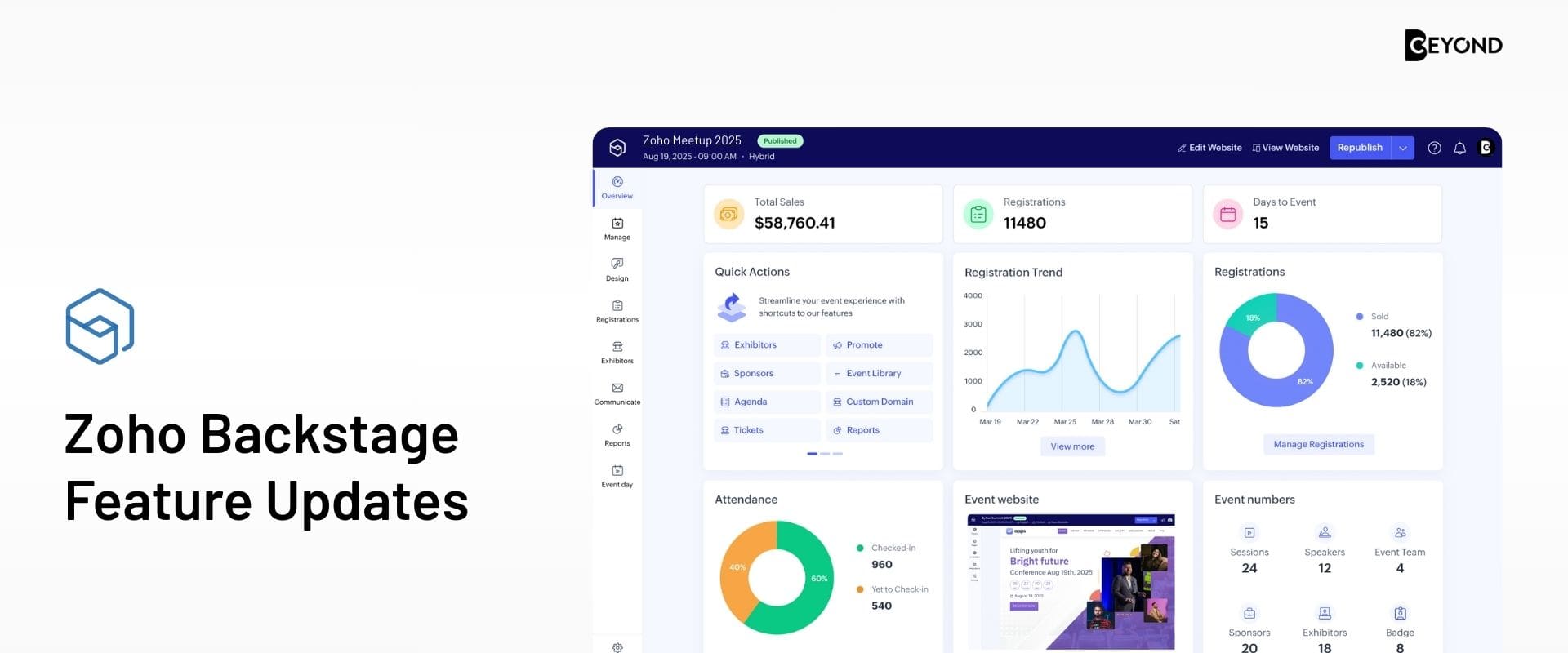
Zoho Backstage continues to evolve rapidly – and in 2025, several new features have been added that noticeably simplify your daily event operations. In this article, you will learn which updates Zoho Backstage has introduced, what they can do, and how they help elevate your events to the next level.