







BEYOND DIGITAL

Zoho Analytics 2026: Turning Business Data into Actionable Insights for DACH Companies

Data is available in almost every company today. Sales figures, customer data, marketing metrics, financial numbers and operational KPIs are stored across multiple systems. The real challenge for many organisations in the DACH region is not collecting data, but transforming it into clear, reliable insights that support better business decisions. Zoho Analytics has evolved into a powerful business intelligence platform that addresses exactly this challenge. With new features, deeper integrations and AI-driven capabilities, Zoho Analytics is becoming a central decision-making tool for companies across Austria, Germany and Switzerland in 2026.

A central data platform: Breaking down data silos

One of the key developments highlighted in recent Zoho updates is the focus on unified data management. Companies typically work with multiple tools in parallel – CRM, accounting, marketing, support and project management systems.

Zoho Analytics enables:

  • consolidation of data from Zoho apps such as CRM, Books, Desk and Projects
  • integration of third-party systems via standard connectors and APIs
  • consistent KPIs across departments and business units


For DACH companies, this means fewer manual exports, reduced dependency on spreadsheets and a single source of truth for management reporting.

AI-powered insights with Zia: From data to decisions

Artificial intelligence plays an increasingly important role in Zoho Analytics. Zia, Zoho’s AI assistant, is designed to make advanced analytics accessible even for non-technical users.

Key AI-driven features include:

  • automatic detection of trends and patterns in large datasets
  • predictive analytics based on historical sales, revenue or project data
  • anomaly detection to identify unusual deviations in key metrics
  • natural language queries that allow users to ask questions without SQL or BI expertise

For many mid-sized DACH companies, this removes the need for dedicated data teams while still enabling data-driven decision-making at management level.

Role-based dashboards: Relevant insights for every stakeholder

Another major focus in recent Zoho Analytics enhancements is the expansion of role-based dashboards. Instead of one-size-fits-all reports, dashboards can be tailored to specific user groups.

Typical use cases include:

  • management dashboards with revenue, forecasts and liquidity indicators
  • sales dashboards focusing on pipelines, conversion rates and regional performance
  • marketing dashboards tracking campaign ROI and lead sources
  • finance dashboards monitoring costs, payment behaviour and cash flow


This approach aligns well with the structured reporting culture common in DACH organisations, ensuring transparency without overwhelming users with unnecessary data.

Automated reports and alerts: Control without manual effort

A frequently underestimated strength of Zoho Analytics is report automation. Rather than manually creating and distributing reports, companies can fully automate these processes.

Key capabilities include:

  • scheduled report delivery via email
  • threshold-based alerts for critical KPIs
  • automatically refreshed dashboards
  • traceable and auditable reporting structures


For companies operating in regulated or compliance-driven environments – common in the DACH region – this supports governance, accountability and internal control requirements.

Zoho Analytics as part of the Zoho One ecosystem

For organisations using Zoho One, Zoho Analytics unlocks its full potential through deep integration across the platform. End-to-end analysis becomes possible across the entire customer and value chain.

Examples include:

  • tracking leads from first contact to closed revenue
  • analysing project effort versus profitability
  • linking support performance to customer satisfaction


In 2026, Zoho Analytics is increasingly positioned as the analytical backbone of Zoho One, enabling holistic business oversight rather than isolated reporting.

Best Practices für Unternehmen im DACH-Raum

Experience from projects in the DACH region shows that success with Zoho Analytics depends less on the number of reports and more on a clear analytical strategy.

Proven best practices include:

  • defining relevant KPIs before building dashboards
  • focusing on decision-relevant metrics instead of excessive detail
  • involving business departments early in the design phase
  • regularly reviewing and refining dashboards and reports


The goal should always be to support decisions, not just to visualise data.

Conclusion: Zoho Analytics as a strategic management tool

Zoho Analytics is evolving from a reporting solution into an intelligent decision-support platform. With AI-driven insights, centralised data management and deep integration into Zoho One, it offers DACH companies a scalable and future-proof way to work data-driven.

CEYOND supports organisations in implementing Zoho Analytics not only from a technical perspective, but as a strategic component of their digital business architecture – aligned with local market requirements, regulatory standards and individual business goals.

Latest Stories

With Zoho One 25, Zoho presents a comprehensively redesigned version of its operating system for businesses. The update is based on continuous user feedback, years of development, and the goal of providing you with a unified, simplified, and even more secure software ecosystem. At a time when artificial intelligence and digital transformation are increasingly shaping everyday business operations, Zoho One 25 creates a modern foundation for mapping business processes efficiently and with a future-oriented approach.

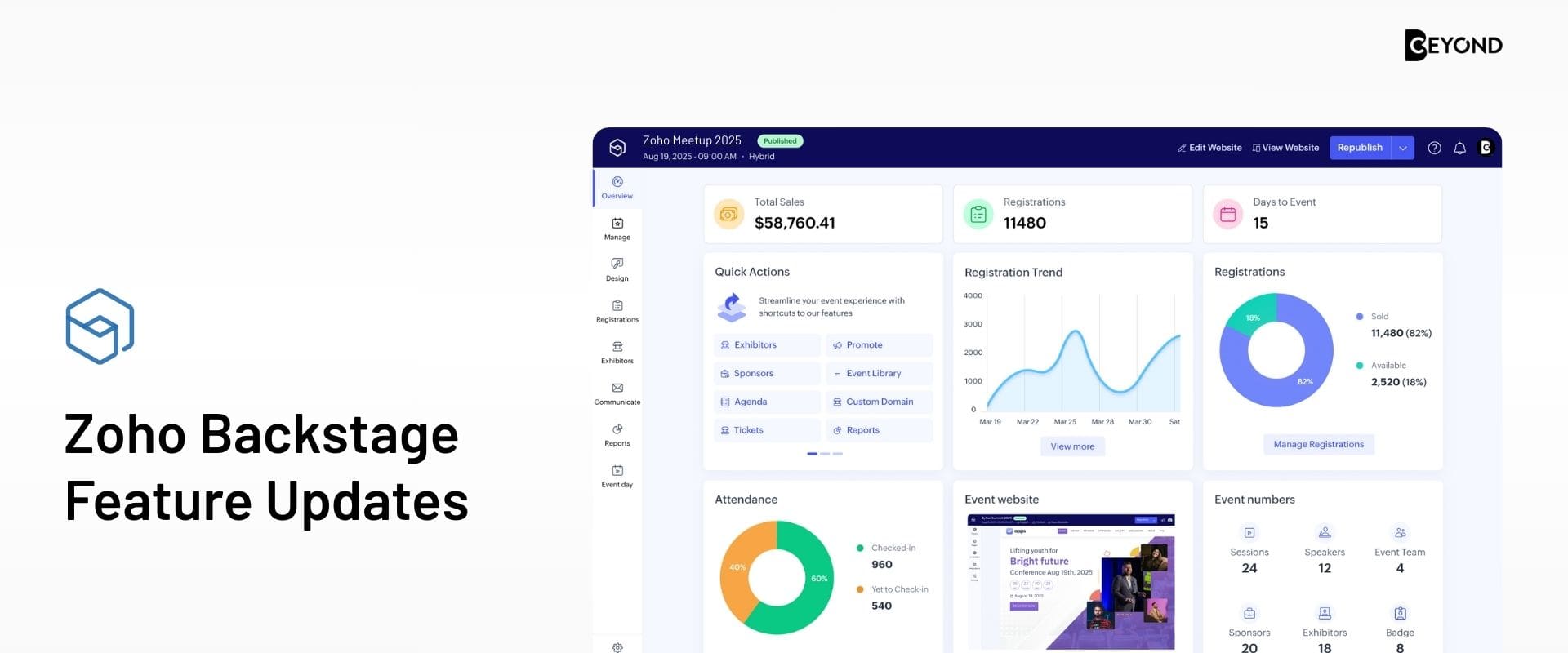
Zoho Backstage continues to evolve rapidly – and in 2025, several new features have been added that noticeably simplify your daily event operations. In this article, you will learn which updates Zoho Backstage has introduced, what they can do, and how they help elevate your events to the next level.


Many businesses struggle with inefficient processes, unclear responsibilities, and fragmented process knowledge. Information is scattered across different tools or individual employees, handovers take too long, and documentation must be gathered again each year for audits. At the same time, the pressure to make processes more transparent, efficient, and digital continues to grow. IBM Blueworks Live provides exactly this support: a central, easy-to-understand platform where you can visualize your business processes, optimize them collaboratively, and standardize them for the long term. CEYOND guides you along this journey – from the first analysis to successful digital implementation.